NIMMSA Conservation Fund Project
Year awarded
Contributing to regional understanding of juvenile Chinook salmon
Awarded Organization:
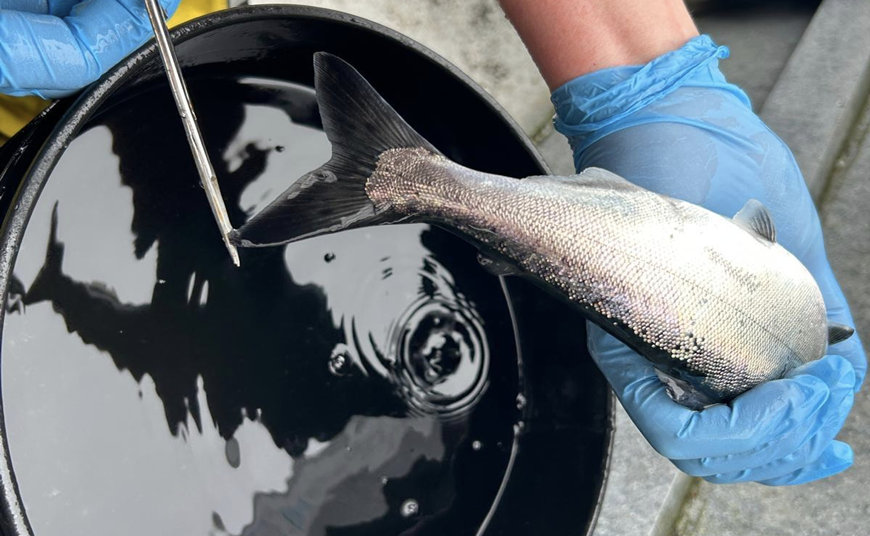
Fund field work to collect samples from juvenile Chinook overwintering in the Broughton Archipelago, feeding into a larger regional dataset on juvenile Chinook migration patterns and health.
Chinook populations have declined across coastal BC. The first winter at sea is thought to be critical for survival, but little is known about it. Better data on habitat use and movement would support management and conservation.
Approach
-Microtrolling in the Broughton Archipelago and Johnstone Strait, a technique with low bycatch and low impact; fish are released where caught.
-Small tissue samples are taken and sent to the lab to identify river system of origin and genomic indicators of health.
-Sampling covers a broad geographic area to look for “hotspots” where juveniles congregate, tracked over multiple years to see whether patterns are consistent.
Chinook salmon are a keystone species. They matter socially, culturally and economically to coastal communities, and they are a dietary cornerstone for many marine species, including orcas and seals. Yet very little is known about the first winter Chinook spend in the ocean, even though it is thought to play a critical role in their survival.
With support from the NIMMSA Conservation Fund, Salmon Coast Society continued its overwintering Chinook monitoring in the Broughton Archipelago. The team used microtrolling, a technique with low bycatch and minimal impact on the fish, which are returned to the water where they were caught. Small tissue and scale samples were sent to the lab to identify each fish’s river of origin and to reconstruct its growth history, disease status and signs of stress.
What was accomplished
In the 2025-2026 season, the team sampled 12 juvenile Chinook. That is fewer than in recent peak years, but consistent with the program’s early seasons, and the samples will still yield meaningful results. The work was carried out by a crew lead and a local First Nations field technician, with accommodation provided in-kind by Salmon Coast.
Why it matters
The samples feed into a coast-wide dataset led by the Pacific Salmon Foundation’s Bottlenecks to Survival program. Most partner researchers are based in the Salish Sea and the west coast of Vancouver Island, so Salmon Coast fills an important gap by representing the North Island, where overwintering fish likely face distinct challenges. The stock ID and health data inform First Nations and government managers on decisions about fisheries regulations, protected areas and habitat restoration.
Lab delays mean results from this season aren’t available yet. Earlier seasons, however, produced a surprising finding: juvenile Chinook from Rivers Inlet travel south to the Broughton Archipelago and overwinter in the inlets bordering Blackfish Sound. Once this season’s analysis is complete, the team expects more insight into the roles of parasites, pathogens and physiological stressors such as hypoxia, salinity and starvation in overwinter mortality.
Looking ahead
Each season adds to a growing multi-year dataset that will show how conditions for juvenile Chinook in the North Island are changing and what the key stressors are during that vulnerable first winter. Salmon Coast hopes to continue this work and to share outcomes with community partners.