NIMMSA Conservation Fund Year
2025
Number of applications:
11
Grants awarded:
5
Total awarded funds:
$47,564
Awarded Organizations:
Projects
Contributing to regional understanding of juvenile Chinook salmon
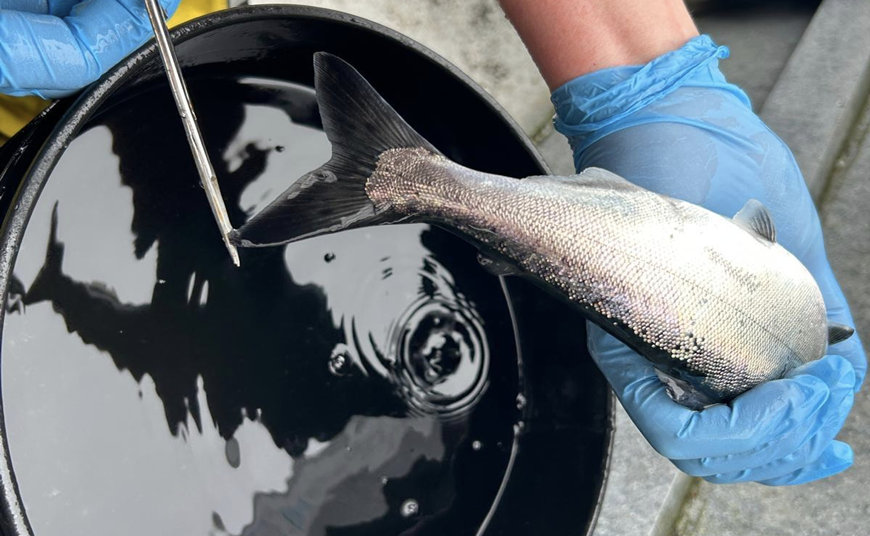
Chinook salmon are a keystone species. They matter socially, culturally and economically to coastal communities, and they are a dietary cornerstone for many marine species, including orcas and seals. Yet very little is known about the first winter Chinook spend in the ocean, even though it is thought to play a critical role in their survival.
With support from the NIMMSA Conservation Fund, Salmon Coast Society continued its overwintering Chinook monitoring in the Broughton Archipelago. The team used microtrolling, a technique with low bycatch and minimal impact on the fish, which are returned to the water where they were caught. Small tissue and scale samples were sent to the lab to identify each fish’s river of origin and to reconstruct its growth history, disease status and signs of stress.
What was accomplished
In the 2025-2026 season, the team sampled 12 juvenile Chinook. That is fewer than in recent peak years, but consistent with the program’s early seasons, and the samples will still yield meaningful results. The work was carried out by a crew lead and a local First Nations field technician, with accommodation provided in-kind by Salmon Coast.
Why it matters
The samples feed into a coast-wide dataset led by the Pacific Salmon Foundation’s Bottlenecks to Survival program. Most partner researchers are based in the Salish Sea and the west coast of Vancouver Island, so Salmon Coast fills an important gap by representing the North Island, where overwintering fish likely face distinct challenges. The stock ID and health data inform First Nations and government managers on decisions about fisheries regulations, protected areas and habitat restoration.
Lab delays mean results from this season aren’t available yet. Earlier seasons, however, produced a surprising finding: juvenile Chinook from Rivers Inlet travel south to the Broughton Archipelago and overwinter in the inlets bordering Blackfish Sound. Once this season’s analysis is complete, the team expects more insight into the roles of parasites, pathogens and physiological stressors such as hypoxia, salinity and starvation in overwinter mortality.
Looking ahead
Each season adds to a growing multi-year dataset that will show how conditions for juvenile Chinook in the North Island are changing and what the key stressors are during that vulnerable first winter. Salmon Coast hopes to continue this work and to share outcomes with community partners.
Know your neighbours: fine-scale site fidelity of Humpback Whales (Megaptera novaeangliae) within their British Columbia feeding ground

Humpback whales travel thousands of kilometres every year to migrate, but once they arrive in British Columbia, do they roam the coast or stay close to home? With support from the NIMMSA Conservation Fund, MERS set out to answer that question.
The team analyzed more than 76,000 sightings of 4,767 individual whales, collected by over 873 data contributors. Many were citizen scientists, ecotourism operators and coastal community members, brought together through the Canadian Pacific Humpback Collaboration.
What they found
- Whales show strong “site fidelity.” Researchers identified 10 sub-areas along the BC coast, each with its own group of whales and little mixing between them.
- About 70-80% of whales seen in a given year had been seen in the same sub-area in a previous year.
- Within BC, individual whales typically move only about 70-180 km.
- Whales that use specialized feeding techniques, like bubble-net feeding, tend to stay closer to home, and calves tend to show similar loyalty to their mothers.
- This points to a possible culturally passed-down form of population structure, where whales rely on knowledge of particular areas that they return to each year.
Why it matters
Because different whales use different areas, local threats like vessel traffic, fisheries interactions and prey shifts may affect some individuals far more than others. The same is true in reverse: local actions like ghost gear cleanup and boat speed reduction can make a real difference for the whales that live here.
Sharing the science
The research has been submitted for publication in the open-access journal PLoS One. It has been presented at the Humpback Whale World Congress, the Biennial Conference on the Biology of Marine Mammals, the Campbell River Ocean Day event and a NIMMSA Community Meeting.
Thank you to MERS and to everyone who contributes whale sightings along our coast.
Contributing to regional understanding of juvenile Chinook salmon

Awaiting Final Reporting
Marine Stewardship in Mamalilikulla Territory

Awaiting Final Reporting
Long-term Acoustic Monitoring and Orca Conservation Education

Awaiting Final Reporting.
Bigg’s Killer Whale Database Development and Population Monitoring

With support from the NIMMSA Conservation Fund, Bay Cetology expanded the finwave platform and employed a biologist to manage incoming data and enhance the system. The project resulted in significant growth, including a 313% increase in users and a 57% increase in recorded whale encounters. By making curated data widely accessible, finwave continues to advance research, education, and stewardship, improving understanding of whale movements, behaviour, and population dynamics.